

|
For years, Raffles Education was a stock investors paid little attention to, plagued by high debt and boardroom battles. |
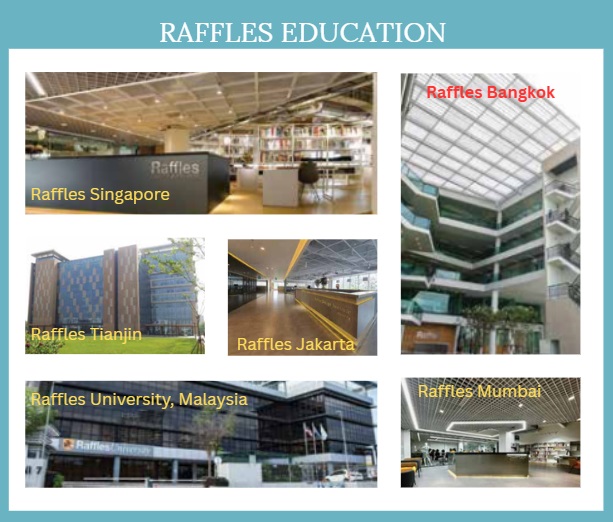 Raffles Education has been refining its geographic focus, expanding in ASEAN and reducing its China footprint.
The stock has staged a strong comeback, rallying over 280% in the past year from a low of 4 cents to around 15 cents.
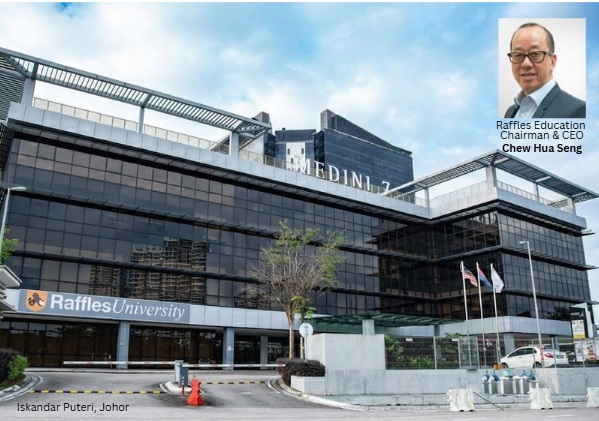
As KGI Research in its initiation report points out, the company’s market capitalisation is currently around $230 million, yet it sits on net assets worth approximately $640 million, mostly freehold properties across Asia.
This means the stock is trading at roughly 0.36 times its book value.
The $640 million net asset figure (as of June 2025) is calculated after subtracting all liabilities, including ~$200 million debt, per the KGI report:
| • Total Assets: ~S$1.018 billion (properties, cash, etc.) • Less Total Liabilities: ~S$378 million (including ~S$200m in borrowings) • Net Assets: ~S$640 million |
This is why the gap between the market cap (S$230 million) and net assets (S$640 million) is considered a deep discount.
KGI Securities analyst Chen Guangzhi, who has an "Outperform" call and a target price of 34 cents, describes this as an "attractive asset-value arbitrage".
"The rental assets alone are worth roughly the Group's entire market cap, implying investors are effectively getting the core education business and remaining land bank for free - offering a wide margin of safety."
| An influx of cash from asset sales |
Raffles Education had been liquidating relatively some non-core assets in China well before the headline-grabbing deals starting from late 2025.
Thus, Raffles Education's balance sheet has been transformed from that of a distressed borrower into a cash-generating special situation play, with substantial interest cost savings.
|
• Singapore Asset Sale: In Dec 2025, the company sold its corporate office at 51 Merchant Road, a non-income-generating asset, for S$121.8 million. In another real estate sale in China, the company announced on 29 Jan 2026 that the local government in Langfang City, Hebei Province, intends to repossess its land for urban planning.
|
Finance expenses fade as debt is repaid through asset sales:
|
Year |
Finance expenses ('000) |
|
2024 |
(20,293.0) |
|
2025 |
(16,640.0) |
|
2026F |
(14,105.4) |
|
2027F |
(7,393.2) |
|
2028F |
(1,218.2) |
|
Source: KGI Securities |
|
| Why Caution is Still Needed |
Despite the compelling valuation, this is not a risk-free bet.
China Execution Risk: While the asset sales look good on paper, moving money out of China can be difficult due to capital controls.
Investors will watch to see if the proceeds from Hefei and Langfang compensation can be successfully repatriated or used to pay down offshore debt.
Operational challenges: The student enrolment decline in FY25 to about 17,200 from above 22,000 (in 2022-2025) highlights ongoing demand volatility amid competitive and cyclical pressures, says KGI.
Operating across multiple jurisdictions also exposes the Group to regulatory shifts, while rising staff costs, inflation, and currency movements pose margin risks.
Raffles Education is a "special situation" because the thesis doesn't rely on explosive growth in student numbers. High net worth investors have taken notice. They bought at 12.7 cents a share, signalling perhaps a belief that the bottom is in. |
See also: RAFFLES Reborn: Lower Debt, Higher Value, and Asean Potential


