

|
A recent article by The Edge Singapore has shed more light on why Azure Capital has taken a substantial stake in Trek 2000 International. The interview with Azure founder and CEO Terence Wong comes less than two months after Azure emerged as a shareholder in Trek. The transaction was significant not simply because Trek gained a new institutional shareholder. Trek’s share price subsequently surged from below 10 cents to as high as 30.5 cents, before closing at 25.5 cents on July 24. At that price, the company was valued at around S$77 million. |
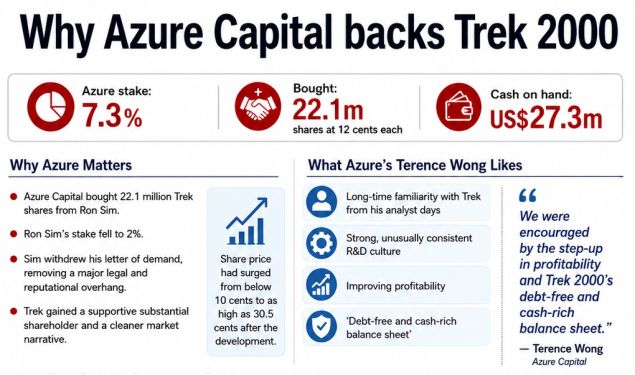
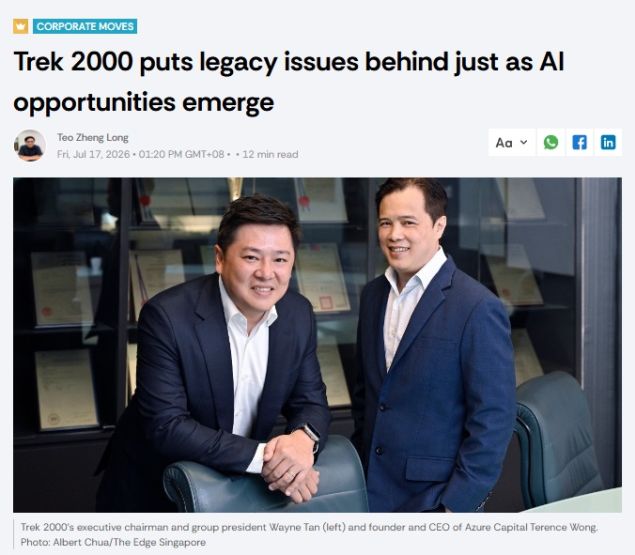
The market reaction suggested that investors saw Azure’s entry as one where the new shareholder was prepared to publicly support its technology, balance sheet and growth prospects.
In the interview, Terence said he had followed Trek for many years, dating back to his time as a sell-side technology analyst.
His investment case is not built solely on nostalgia for Trek’s most famous invention, the ThumbDrive —the USB flash drive that revolutionized portable storage.
He said he was impressed by the company’sy strong and sustained focus on research and development. He also highlighted the improvement in profitability and Trek’s “debt-free and cash-rich balance sheet” as a foundation for growth.
That balance sheet is central to his positive view.
Terence said few companies in Singapore possess Trek’s combination of fundamental strength and a debt-free financial position.
The cash, in his view, gives management the flexibility to invest in technology, pursue strategic transactions and create value for shareholders.
|
Trek highlights (US$’000) |
FY25 |
FY24 |
Δ (%) |
|
Revenue |
19,635 |
19,850 |
(1.1) |
|
Gross Profit |
2,375 |
1,038 |
+128.8 |
|
Gross Profit Margin |
12.1% |
5.2% |
+6.9 pts |
|
Net Profit Attributable to Owners* |
4,609 |
335 |
+1,275.8 |
|
Net Profit Margin |
23.4% |
1.6% |
+21.8 pts |
|
* Includes US$6.1 m gain on disposal of unquoted investments |
|||
Terence therefore appears to be backing two things.
The first is Trek’s technological capability and intellectual property.
The second is its financial ability to fund a new growth strategy without being immediately dependent on bank borrowing or repeated equity fundraising.
| Wayne Tan explains Trek’s current core business |
The recent interview also gave executive chairman and group president Wayne Tan an opportunity to explain what Trek actually does today.
The company is no longer simply a seller of USB thumb drives. It is now organised around three principal business areas.
Its Artificial Intelligence of Things, or AIoT, segment develops applications that combine memory-based solutions with AI capabilities.
A second segment designs customised solutions for specific customer requirements.
The third applies AI capabilities to solar-energy systems.
The performance of the 3 segments in FY2025:
| (US$’000) |
Customised Solutions |
Artificial Intelligence of Things |
AI Renewable Energy Solutions |
Corporate |
|
Segment revenue |
542 |
18,316 |
777 |
– |
|
Segment (loss)/profit |
(101) |
(3,422) |
(145) |
7,487 |
Wayne describes Trek primarily as an application-focused R&D company.
“We do not develop hardware or solutions from scratch,” he said. Instead, Trek integrates different technologies and adapts them into applications that address customers’ needs.
| Applications |
 “We do not develop hardware or solutions from scratch. Instead, we focus on application-based R&D where we integrate different technologies to serve our potential customers,” “We do not develop hardware or solutions from scratch. Instead, we focus on application-based R&D where we integrate different technologies to serve our potential customers,”-- Wayne Tan, Executive Chairman & CEO, Trek 2000 |
One example is Trek’s partnership with US software developer Aboard AI.
The companies are developing an AI-enabled aviation solution combining Trek’s patented wireless-memory technology with Aboard AI’s algorithms.
The system is intended to collect and process flight data and provide pilots with information such as the runway distance, speed and angle needed for take-off or landing.
Trek is targeting the general-aviation industry, including private jets and personal aircraft, rather than major commercial airlines, which typically already have advanced technology installed.
Management has projected that the partnership could generate more than US$15 million in revenue and contribute positively to FY2027. Wayne also said Trek was negotiating to extend the contract further.
| Profit, not revenue, is priority |
Wayne’s comments suggest that Trek is trying to avoid taking on projects merely to enlarge its reported revenue.
He said profitability is the company’s first consideration when selecting projects. Trek also examines the customer’s profile, the long-term sustainability of the solution, capital expenditure requirements and cash-flow implications.
Management prefers recurring projects because they can provide revenue visibility over two or three years, compared with one-off design or product orders.
This more financially cautious approach comes as Trek attempts to build on its FY2025 turnaround.
The next stage depends on whether projects such as the Aboard AI collaboration can produce recurring operating profits and cash flow.
The Edge interview strengthens the case for viewing Azure as Trek’s saviour—but mainly in a capital-market and reputational sense.
Azure did not inject new money directly into Trek but provided Trek clean break. The narrative is now clearer: legacy issues are being pushed into the background just as new AI opportunities emerge. The real test will be whether the company can convert its patents, partnerships and cash reserves into sustainable core earnings from its minimal profits in FY2025 and prior years. Azure has helped rescue Trek’s investment story. Trek must now demonstrate that the underlying business can follow. |
|||||||||||||||||
 → See also:New Chapter for Trek 2000: Azure Fund Steps In Amidst Strong FY25 Results


