

|
Salt Investments’ FY2026 AGM on 29 Sept had a noticeably upbeat tone. Instead of dwelling on restructuring and legacy issues, CEO Dennis Goh spent much of the meeting talking about growth, oil trading and — most importantly — profitability. “We have largely completed” the turnaround, and the company is now moving into a profitability phase, he told shareholders. |
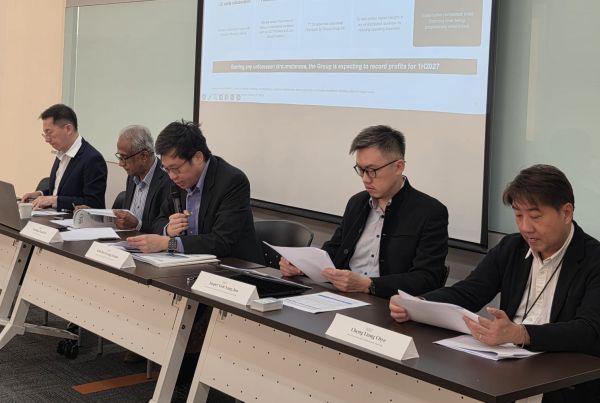 At Salt AGM (L-R): Ng Joo Khin, company secretary | Chellapa Panickar, CFO | Dennis Goh, CEO | Jasper Goh, Independent and Non-executive Chairman | Cheng Liang Chye, Independent and Non-executive Director. Photo: Rishika Tiwari
| Oil could change the numbers |
The main earnings driver going forward is expected to be Salt’s emerging oil distribution, physical supply and fuel-bunkering business.
Initial oil trades have already been completed, while trade-financing lines are progressively being established.
Salt’s model is straightforward: draw trade finance, purchase cargo, deliver the oil, receive payment, repay the facility and reuse it for the next transaction.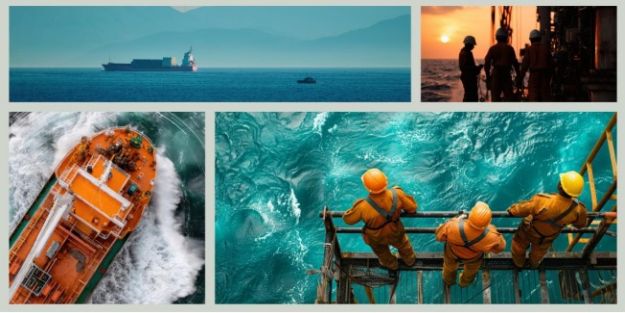
The significance is that rapid growth does not necessarily require Salt to continually issue new shares.
Its AGM presentation described the model as being funded by “trade finance secured on cargo, not shareholder equity”, although the speed at which the business can expand will depend heavily on the availability of such financing.
Salt has also secured its first vessel to support its physical oil and bunkering operations, reduce reliance on third-party chartered vessels and improve margins.
Management also believes owning or controlling its own vessel strengthens its credibility with customers and helps it compete for contracts.
| Technology remains the bigger ambition |
At the AGM, Dennis emphasised that the marine and oil businesses are the operating foundation on which a technology platform will be built, rather than the final destination.
The proposed integrated maritime technology platform is intended to digitalise transactions and improve productivity and financing access across the maritime supply chain.
Dennis says much of the maritime SME supply chain is still surprisingly manual — information moving through WhatsApp, photos, and standalone accounting/CRM systems. The platform is intended to connect these fragmented steps digitally.
Salt has secured a technology licence with worldwide maritime exclusivity.
The platform is still under development, with feasibility work and a technology consortium being progressed.
In the annual report, the CEO says Salt is in “active discussions with several technology strategic partners to form a consortium”.
|
Stock price |
$0.002 |
|
52-week range |
$0.001-$0.005 |
|
Market cap |
S$52 m |
|
52-week change |
-33% |
|
PE (ttm) |
-- |
|
Dividend yield |
-- |
|
P/B |
3.4 |
Goh stressed that Salt's existing operating businesses will become the platform's first users.
What about share dilution? There was also a clarification during the Q&A.
Dennis said Salt now has less need to pursue acquisitions, as its existing businesses can increasingly be grown organically.
When a shareholder asked about the annual share-issue mandate, management explained that it gives the company flexibility but does not mean another placement is imminent.
For shareholders, 1H FY2027 (which effectively has ended) will be scrutinised for an acceleration in business. |

 → See AGM deck here.
See also earlier story:Improving Margins and Institutional Backing: The Evolution of SALT INVESTMENTS is Taking Off?
