

|
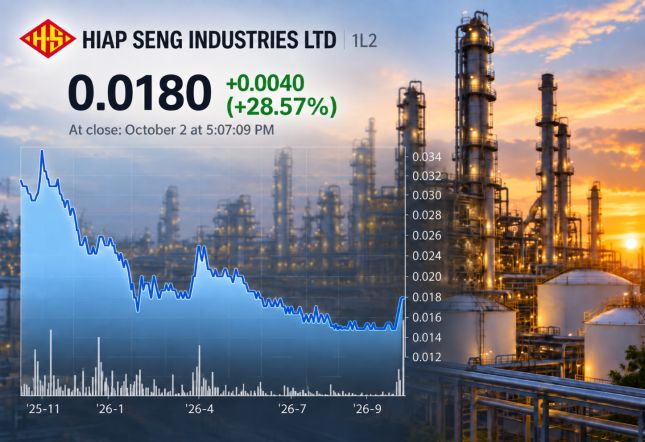
Hiap Seng Industries suddenly came alive on Friday (2 Oct), surging 28.6% to 1.8 cents after touching an intraday high of 1.9 cents. More striking was the volume: 159.4 million shares worth S$2.67 million changed hands, versus just 5.1 million shares the previous day. Late in the session, there were repeated “Buy Up” trades at 1.7 cents, including blocks of 823,000, 799,900, 600,000, 300,000 and 290,900 shares. The combination of huge volume and sharply higher prices suggests the market was genuinely reassessing Hiap Seng. But the final few trades at 1.8 cents were tiny. |
| Why the excitement? Chandra Asri |
The catalyst is clear: Chandra Asri Trading Company.
Part of Indonesian petrochemical giant Chandra Asri Pacific, it has bought 250.63 million Hiap Seng shares from Tian Yuan for S$2.757 million, or 1.1 cents apiece, in an off-market transaction.
That lifted Chandra Asri's stake from 11.01% to 16.18%, or 784.27 million shares.
Tian sold his entire remaining 250.63 million shares, reducing his 5.17% stake to zero.
Chandra Asri Pacific is no small strategic investor: its recent market cap on the Jakarta Stock Exchange was Rp147 trillion, equivalent to S$10.5 billion.
Chandra Asri, together with Glencore, owns Singapore-based Aster Chemicals and Energy — operator of the former Shell refinery, cracker and chemical assets on Bukom and Jurong Island.
That makes it a particularly strategic shareholder for plant-maintenance specialist Hiap Seng.
| Who is Tian Yuan? |
Tian was one of the investors who helped recapitalise Hiap Seng during its restructuring.
He is a Singapore permanent resident with deep construction experience. He was South-east Asia regional director of China Construction Third Engineering Bureau from 1998 to 2010, before becoming CEO of CGC Group, which has undertaken construction and infrastructure work in Singapore and Malaysia.
Under Hiap Seng's restructuring, which was put to shareholders in 2023 and completed in February 2024, Tian committed S$2 million for 368.3 million subscription shares at 0.543 cent each and received options for another 368.3 million shares.
He subsequently exercised his remaining options at 0.597 cent before gradually reducing his holding.
Tian looks like a successful restructuring investor cashing out.
(Another white knight was Vibrant Equities which still owns around 45.6% as the No.1 shareholder).
| Chandra Asri is a different animal |
Chandra Asri is not primarily a financial investor.
Together with Glencore, it formed Aster, which bought the former Shell Singapore assets in April 2025: a 237,000-barrel-a-day refinery, a 1.1-million-tonne-a-year ethylene cracker naphtha cracker on Bukom and substantial downstream chemical assets on Jurong Island.
Those are the sorts of plants that require Hiap Seng's maintenance, shutdown, mechanical construction and upgrading services.
When Chandra first entered Hiap Seng in 2025, both sides explicitly referred to potential strategic collaborations and partnership opportunities.
At its July 2025 AGM, Hiap Seng said it already had “existing and ongoing business engagements” with Chandra Asri before the latter became a shareholder, and that it would actively explore further collaboration.
Hiap Seng's FY2026 revenue was only S$24.4 million, including S$22.7 million from maintenance.
Hiap Seng would need about S$5.8 million of annual profit — roughly double FY2026's level — just to bring the P/E down to 15 times. |


