

|
Geo Energy Resources' stock listed on SGX has been punished by market fears over a nascent government policy. |
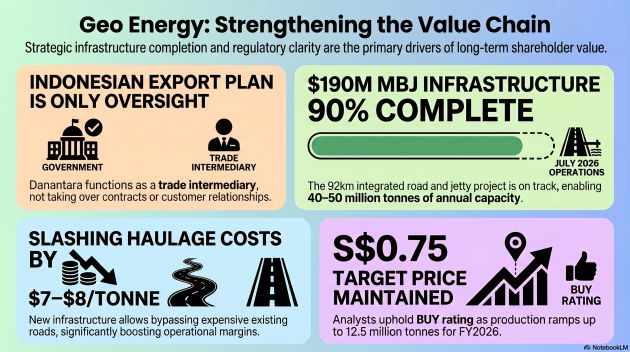
Instead of acting as a market-disrupting consolidator, Danantara is basically going to be a monitoring and compliance outfit — making sure nobody’s under-invoicing or playing games with transfer pricing.
Geo Energy's announcement even quoted Danantara's COO Dony Oskaria clarifying that the fund's goal "was not to take (producers) goods and become a broker who then sells them".
Consequently, Geo Energy confirmed it "does not expect any material impact on its mining operations, logistics, customer relationships, or export activities".
In a June 5 report, Phillip Securities Research had held steady its BUY recommendation and S$0.75 target price while Geo Energy traded lower and lower.
| No disruption |
 "The government reaffirmed that existing trade arrangements will be honoured and that the current trade ecosystem will not be disrupted. Export transactions will continue to be conducted directly between producers and their customers under existing business-to-business arrangements." "The government reaffirmed that existing trade arrangements will be honoured and that the current trade ecosystem will not be disrupted. Export transactions will continue to be conducted directly between producers and their customers under existing business-to-business arrangements."-- Charles Antonny Melati, Executive Chairman and CEO, Geo Energy Resources |
Analyst Paul Chew noted Geo Energy's execution of strategic moves offered significant upside.
To offset its TBR mine's decline in coal reserves, the company is shifting its focus to the larger TRA mine, where production is expected to reach 6 million tonnes in FY26, up from 2.5 million tonnes in FY25.
Furthermore, the new US$190 million, 92-km integrated infrastructure project operated by subsidiary Marga Bara Jaya (MBJ) is set to be completed in July 2026.
This infrastructure will allow the company to "transfer coal haulage from existing roads that charge US$7 to US$8 per tonne, providing significant cost savings".
In a commodity business where you can't control the selling price, the low-cost operator wins.
Geo Energy: "The Group's large-scale coal resources, shipping businesses, MBJ Integrated Infrastructure, and established customer relationships position it favourably to support Indonesia's long-term energy and export objectives."
With regulatory fears expected to fade quickly, focus will return to Geo Energy’s robust operational catalysts. Its operational catalysts should once again asset themselves in the market, especially with the price Geo Energy is getting for its coal -- the 4200 GAR index sits nicely at around US$64 a tonne versus US$41 a year ago. |
 → See also:Why a Swiss Investor Just Valued One Piece of GEO ENERGY at US$1.5 Billion


